when

I live in a world of “when.”
When this happens, I will…
I remember when…
 
When is always looking forward and always looking back.
I’m not sure how happy I am with either at this point in my life.
It’s not like I’m one of those people who doesn’t want to look back with regret. Because I believe regret teaches us a great deal. And it’s not like I’m scared of the future (ok. I probably am.)
But I’m just so weary of when.

Thinking about “what if” or “what could been” is exhausting. I’m struggling, at this point in my life, to glean what is helpful and what isn’t from when. I guess because it keeps me from being present. It keeps me from being happy right now. It keeps me from seeing all the blessings and the gifts that are right in front and me because “when” simply makes me go “WAAAAAH. I want it that way instead.”
When I get my act together, surely I will be happy.
When I was younger, things seemed so much easier.
When I just…
It was so much better when…
 
Waaaaaah indeed.

“Patience is a hard discipline. It is not just waiting until something happens over which we have no control: the arrival of the bus, the end of the rain, the return of a friend, the resolution of a conflict. Patience is not a waiting passivity until someone else does something. Patience asks us to live the moment to the fullest, to be completely present to the moment, to taste the here and now, to be where we are. When we are impatient we try to get away from where we are. We behave as if the real thing will happen tomorrow, later and somewhere else. Let’s be patient and trust that the treasure we look for is hidden in the ground on which we stand.” -Henri Nouwen

This post is part of Five Minute Friday, when I write for 5 minutes without agonizing over every little thing I type. It’s fun, sometimes. Other times it hurts. But it’s always good for me.

unsafe people


I’ve been thinking a lot about safe people in the last several months, mainly because I’m in a situation where being able to have safe people is 100% needed for what I’m going through, and I need to able to identify those who are safe(who may already be in my life.)


There always seem to be people in our lives who are afraid to have the more intimate and hard conversations with you, even when it doesn’t involve your own 
friendship/relationships, but maybe a difficult situation you are going through on your own.

There is the friend who avoids and says things, “Well, let’s try not to think about that.” Or the silent friend, who just doesn’t text back and after a few days of silence you’ve forgotten you’ve even asked them or told them what you were going through. (But you really didn’t, because you wouldn’t have asked them if you didn’t really want their thoughts.) There is the friend who gives you terrible advice, the friend that “can’t believe this is happening.” And the “get over it” friend.

This behavior is what many would consider sympathy and not intimacy. Here is an ESSENTIAL video to watch for understanding this.  http://goo.gl/PwxOJi

I’m not saying there is anything wrong with these friends… you should cherish all those you have in your life, because I believe God has put every person in your path for a reason. But I also know that these are what Cloud and Townsend would likely label as “unsafe people”

Link to their book this here: http://www.amazon.com/Safe-People-Relationships-Avoid-Those/dp/0310210844

Unsafe people aren’t always bad people – they just don’t have the ability to be intimate with others. That makes them unsafe, especially when you try to be intimate with them.


Unsafe people act as if they have it all together instead of admitting their weakness.  And this can manifest itself in one very interesting way: they may not *actually* admit they are perfect, but they let you go on feeling as if you are the only one with problems.  For example, they might tell you that you’ve blown something out of proportion or that your feelings are invalid because “that’s not how they meant it.” Or they might say “You’re overreacting.” and tell you how you should be feeling. In this process, they make you feel like you are weak, because they never admit weakness or struggles with you. All the weakness remains on your side.

The result is feeling disconnected from them, because intimacy is born out of sharing weaknesses and friendship involves sharing vulnerabilities.

Finding and having and keeping safe people in your life is really hard. And sometimes people who don’t start out as safe end up 100% being so, because God does a tremendous work in their lives and they finally understand how to be an emotionally healthy person.

And sometimes the person you thought was safe ends up not being so, and that is painful because betrayal is usually the emotion you end up feeling. 

“The first time we get hurt by an unsafe person – or even a reasonably safe one – there is always a period of surprise as we begin the painful adjustment to the realities of unsafety.” (pg. 62)

So much of this comes down to a core question, “Can I be myself with them?” 

Do I have to try too hard? Do I have to pretend?

Cloud and Townsend give some other characteristics of unsafe people:

  • They are self-righteous. 
  • They demand trust. And when their façade of perfection is stripped away they blow up or disappear. 
  • They abandon you or fight you when things get tough (especially in the context of your friendship/relationships). 
  • They make promises with which they don’t follow through. 
  • They bring out the worst in you.

These things don’t drive connection. They drive uncertainty, mistrust, emotional detachment, and fear.

I still have most of the second half of the book to finish, which talks about safe people, how to identify and how to be one. I’ll be writing about this later.

When I think about all I’ve been through in the last year, and the people who were safe and unsafe with me, I can’t help but wonder how much is mine own fault and how much isn’t. And if it’s even worth assigning blame, because at this point all I want to do is move on and get through this. 

But I also know that getting through something involves the swampland of the soul… some shame and vulnerability… some self-examination and pain.


I don’t want the swampland of my soul to be unsafe for anyone. Because I’ve felt it when someone’s has been unsafe for me and it hurts. Just like I want and need to take a shotgun to my shame, I want to take all the unsafe parts of me and blow them up, too. 

keep


I’ve kept you long past our expiration date.

 
You see, INFJs tend to do that. Because connection with others is like the white buffalo for us, we will often fight tooth and nail to keep that someone we connect with in our lives. Even when it’s unhealthy… Or one-sided…Or all about them.
 
But I want to keep them.
 
Says my inner self, who has never been known for her good decisions.
 
[She’s never been good at letting go, either]
 
Did you know that a keep is a tower built within the walls of castles during the Middle Ages? They were used as a refuge of last resort should the rest of the castle fall to an enemy.
 
“Last resort.” Yeah. Ok. I get it.
 
I guess I could keep them as a last resort, if nothing else works. But sheesh. Do you have to be so obvious, hearthead?
 
Have you ever heard that phrase, “I just can’t quit you”?
 
That’s how I feel every day.
 
I’ve kept you long past our expiration date. I don’t care how sour the milk tastes. I love having you around.
 
But I love all kinds of things that aren’t good for me.


This post is part of Five Minute Friday, a link up of awesome bloggers.


boundaries


I confess – I’m probably the only Christian in the world who hasn’t read the Boundaries book by Cloud and Townsend. I own a copy but I just haven’t gotten around to reading it. Last year my best friend tried to convince me of its hallowed greatness, demanding I read it, or at least part of it, while I was out in Colorado visiting him. And I did read a bit, but apparently it wasn’t enough to peak my interest at that time, because my copy still remains untouched.

He explained some of his interpretation of it to me. So that’s the idea I have in my head as I consider what it looks like to redraw boundaries with people already in my life. He explained that when someone has a disproportionate reaction to something you say or do, that’s how you figure out what their boundary is – in a nutshell, leave that subject alone and don’t bring it up with them again. That’s a boundary with them.


I don’t know that I have a person in my life with which I don’t have a boundary. Maybe that’s good, maybe that’s bad… I really don’t know (as I haven’t read the book.) But I know that as you grow more intimate with some people, it does seem necessary to redraw boundaries for your own mental health. Or maybe even in response to boundaries they appear to be drawing with you. I say this because as you begin to see how they react to the greater intimacy, it’s revealed to you just how much they can deal with and just how much you can deal with. (I really don’t know if that makes sense to you, but it does in my head.)

It’s all so messy and confusing. When you have someone in your life that you share a lot of yourself with, it can be hard to step back from that. I’ve discovered recently that there are some people in my life who simply don’t have a way of relating to me when I talk to them about something profound or even life-changing. But they will happily respond to something stupid or silly that I say. Because they used to respond to the profound stuff, I find myself at a loss in understanding what changed in me or in them.

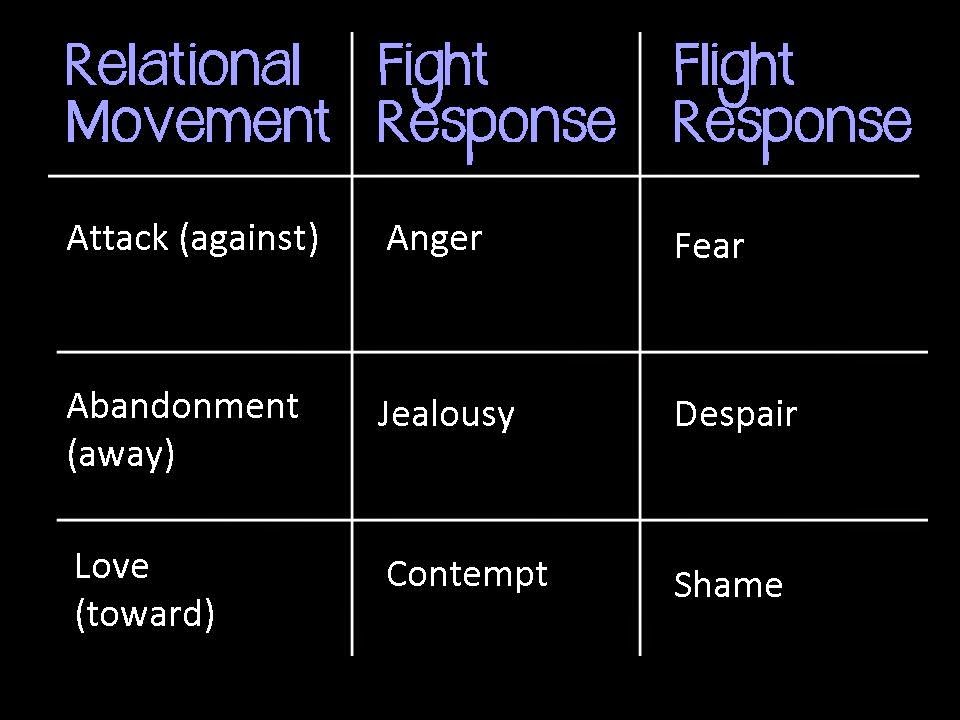
I discovered this chart recently, in some research for a workshop I’m giving this weekend at a women’s conference. 


It’s from the book, Cry of the Soul, by Drs. Dan Allender (one of my favorite authors) and Tremper Longman III. They wrote the book Bold Love, which was an incredibly painful yet powerful look at Godly love for others in the midst of a sinful world. Cry of the Soul helps us understand how our emotions reveal our deepest questions about God.

Anyway, Allender and Longman created this chart.  “Although feelings often seem unpredictable and irrational they are neither random nor unprovoked.” They say. Here is a quick explanation of this chart:

Our emotions are based on our responses to how others deal with us. Our feelings are provoked when people relate to us in one of three ways: 1.) They move against us; attack 2.) They move away from us; abandonment 3.) They move toward us: love.

In the context of a sinful, fallen world, our emotional responses to these relationship movements can generally be characterized as fight or flight. The chart shows how these responses give rise to our difficult emotions.

Attack: anger revolves around the question “IS God just – will He let the wicked win?” Fear centers on the question, “Will God protect me?”

Abandonment: Jealousy asked the question, “Is God good, or will He leave me empty and bless others?” Despair asks, “Will God leave me isolated and alone?”

Love:  Contempt asks, “Does God love me or will He turn away in disgust?” Shame vocalizes the core question, “Does Go love me or will He hate me if He sees me as I really am?”

I bring this all up because I can’t help but wonder about how this connects to the boundaries others place on us or that we place on them. If someone redraws a boundary with you, and stops responding to the painful comments and questions you have about life, is this a relational movement of abandonment? And if so, what kinds of feelings of despair do they have toward you? Toward God?

Or in a far more accurate interpretation of the chart, what feelings of jealously and despair am I having (since I’m the one who feels like part of the relationship has been abandoned) toward the person or toward God?
Like my friend/cousin Meredith says, This. Sh*t. Is. Hard.

yes

I’ve been remiss on my Five Minute Friday posts for so very long. At some point, when my life is no longer in shambles and I’ve over this transition period, I hope to be more consistent. But for the time being, I sit at a makeshift desk in a place that is not mine, and open my heart and my words to you, dear reader.
 
This week’s word: yes


I said yes to someone who said no to me. This is not particularly easy, obviously. It’s a reality of life. A confusing one, and hard one. But it’s there. 
 
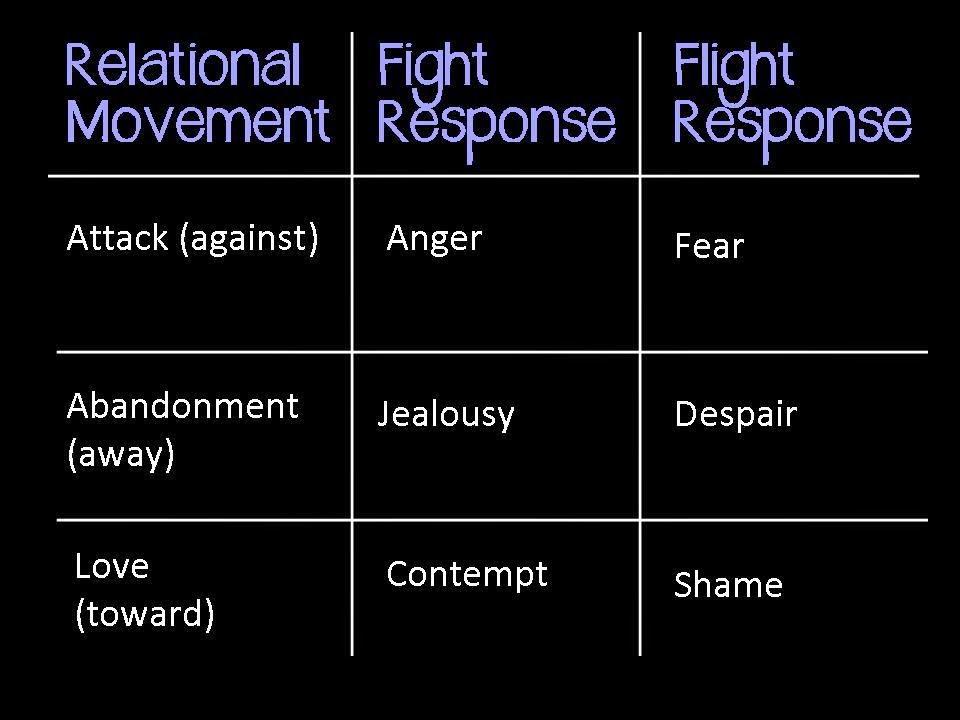
It reminded me of this chart I discovered in the book Cry of the Soul by Dan Allender and Tremper Longman III, which I read early this year for a conference workshop I was preparing. You can read more about it here.


This no was about their hurt. Which grieves me. Hurting someone is just something I never want to do. It happens, though. Inadvertently, I hope, but hurt is inevitable because I am human and flawed. In the midst of this I find myself with a desire for clarification. To listen and hear about their hurt so I don’t do it again. But also a chance to explain myself. A chance to beg for forgiveness.
 
Sometimes a no is because of misunderstandings or assumptions, and when you are not given the chance to explain and clear the air, their no and your yes just seems like the elephant in the room that won’t go away. You want it one way and you want it the other. And you both think you are right. 
 
Moving toward someone with love and grace is a yes according to Allender and Longman. And doing this is so incredibly hard. For years my response was always to run. To avoid. To never move forward. To always say “no.” And then when God finally gave me the courage to say yes and move toward someone, it ends this way. With a no. Seems a little unfair, God. 
 
Yet I am grateful. I can’t fully comprehend why at this point. But I think in part it’s because I’ve learned to own my piece of it. Knowing that I am imperfect, that my sin is messy, and that I hurt someone in my attempts to say yes. However, I think I am grateful because I can’t say that I didn’t try. I said yes.
 
There is more I want to say, but I will not get the chance to say it. Perhaps this is more to be grateful for. I wish for the chance to make it right, because I see this as just another side of my yes. But it’s outside my control and I must learn how to be okay with that. I can only rest in knowing that my yes was enough.